Talent Takeaways from IEDC: What’s Really Working to Attract and Retain Talent
September 24, 2025
At the International Economic Development Council‘s annual conference in Detroit, I had the privilege of attending four sessions focused on talent attraction, retention, and development. From examining Gen Z’s unique challenges to exploring innovative workforce recruitment strategies, these sessions revealed critical insights about the evolving talent landscape.
Here’s what economic developers need to know about building effective talent strategies in 2025 and beyond.
1. The Housing Crisis is the Talent Crisis
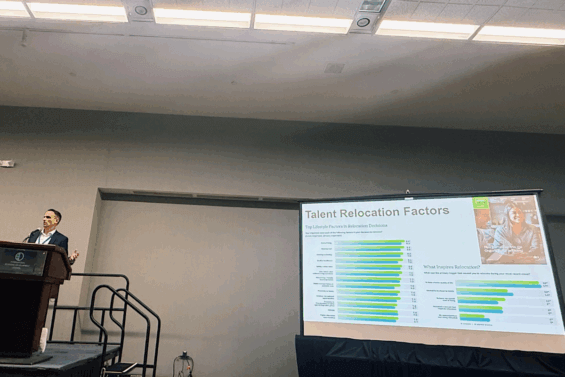
Perhaps the most sobering revelation across multiple sessions was how profoundly housing affordability is shaping talent decisions. In the panel titled “Gen Z and the Future of Local Economies: Why They Stay, Why They Leave, and What We Can Do About It,” speakers noted that the median first-time homebuyer age has jumped from 29 to 36 years over just the past 10-15 years. This isn’t just a housing statistic—it’s a reality that’s shaping a place’s ability to attract and retain talent. Lightcast’s new Talent Attraction Scorecard data reinforced this trend, showing significant out-migration to more affordable markets, which aligns exactly with what we find year after year in our Talent Wars study: the pursuit of financial security is increasingly a driver in relocate.
Meanwhile, in a panel focused on Tulsa Remote, economist Tim Bartik cited his research on the best-in-class talent incentive program, which revealed that housing supply elasticity was critical to the program’s 4-to-1 return on investment. In a simulation where Tulsa had San Francisco-level housing restrictions, the program would have delivered a negative 3-to-1 return instead.
The takeaway: places that are serious about attracting and retaining talent must also address housing affordability and supply.
2. Data-Driven Targeting Beats Generic Outreach
The most successful talent programs shared a common foundation: robust data analysis that informed highly targeted strategies. The Boomerang Greensboro campaign exemplifies this approach perfectly.
Rather than casting a wide net, Action Greensboro used DCI’s Talent Wars study and Lightcast’s migration data to build the foundation of their talent attraction program and target the talent audiences where they would have the highest return. When they discovered their aviation talent was unexpectedly moving to Indianapolis instead of the predicted Wichita or Seattle, they created targeted video content and ran Hulu ads specifically in Indianapolis. In total, the highly targeted program has recruited 100 families back to Greensboro over four years. build the foundation of their talent attraction program and target the talent audiences where they would have the highest return. When they discovered their aviation talent was unexpectedly moving to Indianapolis instead of the predicted Wichita or Seattle, they created targeted video content and ran Hulu ads specifically in Indianapolis. In total, the highly targeted program has recruited 100 families back to Greensboro over four years.
Similarly, Global Detroit‘s immigrant integration programs succeeded because they analyzed occupational data to understand where immigrants were essential to the local economy. Their Skilled Immigrant Integration Program delivered life-changing results—salary increases from $30,000 to $70,000—precisely because it was tailored to specific cultural and professional navigation challenges.
Tulsa Remote’s success also stemmed from data-driven insights about what truly mattered to relocating talent. Their A/B test revealed that $10,000 converted better than $15,000, proving that the financial incentive wasn’t the primary draw—community connection was.
The takeaway: Start with data to understand your specific talent flows, industry needs, and competitive positioning. Generic approaches waste resources and miss opportunities for meaningful impact.
3. The “Third Space” Crisis is Undermining Talent Retention
A theme that emerged across generations and demographics was the critical importance of “third spaces”—gathering places outside of home and work where community connections form. Multiple speakers noted that COVID-19 accelerated the decline of these spaces, with profound implications for talent retention.
The Gen Z-focused panel emphasized that belonging is what keeps young people connected to communities, and that requires intentional creation of spaces for intergenerational collaboration.
The most successful programs understood this need viscerally. Greensboro’s boomerang program didn’t just mail attractive boxes—it created community connections through networking events and professional introductions. Tulsa Remote’s 90% first-year retention rate wasn’t due to the $10,000 payment but rather the programming that helped remote workers build meaningful local relationships.
The takeaway: Talent attraction without retention is expensive failure. Invest in community programming, networking opportunities, and spaces that help newcomers develop authentic local connections.
4. Authenticity and High-Touch Service Trump Big Budgets
Perhaps the most encouraging insight was that successful talent attraction doesn’t require massive budgets—it requires authentic, high-touch approaches that treat potential residents as individuals rather than leads.
Greensboro’s success story perfectly illustrated this principle. Their custom cost-of-living comparisons, personal concierge calls and authentic storytelling created genuine emotional connections.
Michigan’s immigrant integration programs have succeeded through similar high-touch approaches: mock interviews scheduled for specific job opportunities, resume reviews tailored to American hiring practices, and direct introductions to relevant employers. One mechanical engineer from India applied to 2,000 jobs unsuccessfully before the program’s targeted coaching helped him land a position using his existing skills.
Even Tulsa Remote, a program built around a financial incentive, succeeds through personal attention. Every participant receives concierge support, community introductions, and ongoing programming designed to foster genuine connections.
The takeaway: People can sense when outreach is genuine versus transactional. Invest in personalized service and authentic storytelling rather than generic marketing campaigns.
The Future of Talent Attraction is Targeted, Connected, and Community-Centered
These four sessions revealed a talent landscape in transition, where traditional approaches are increasingly ineffective. The communities succeeding in talent attraction and retention share several characteristics: they use data to understand their specific opportunities, they prioritize housing affordability, they create genuine community connections, and they treat talent attraction as relationship-building rather than marketing.
Importantly, they recognize that talent attraction is ultimately about place-making. Places must focus on building the physical environments and support ecosystems that are attractive to potential residents. The communities that understand this shift—and act on it—will be the ones that thrive in the increasingly competitive talent landscape ahead.
The message is clear: generic strategies and surface-level amenities are no longer sufficient. Today’s talent attraction requires authentic community building, data-driven targeting, and a genuine commitment to addressing the structural challenges that shape where people choose to live and work.
Looking to start or take your talent attraction and retention strategy to the next level? Learn more about how DCI can help you attract and retain the best talent to your destination and reach out to SVP of Talent Patience Fairbrother at Patience.Fairbrother@old.aboutdci.com.
